
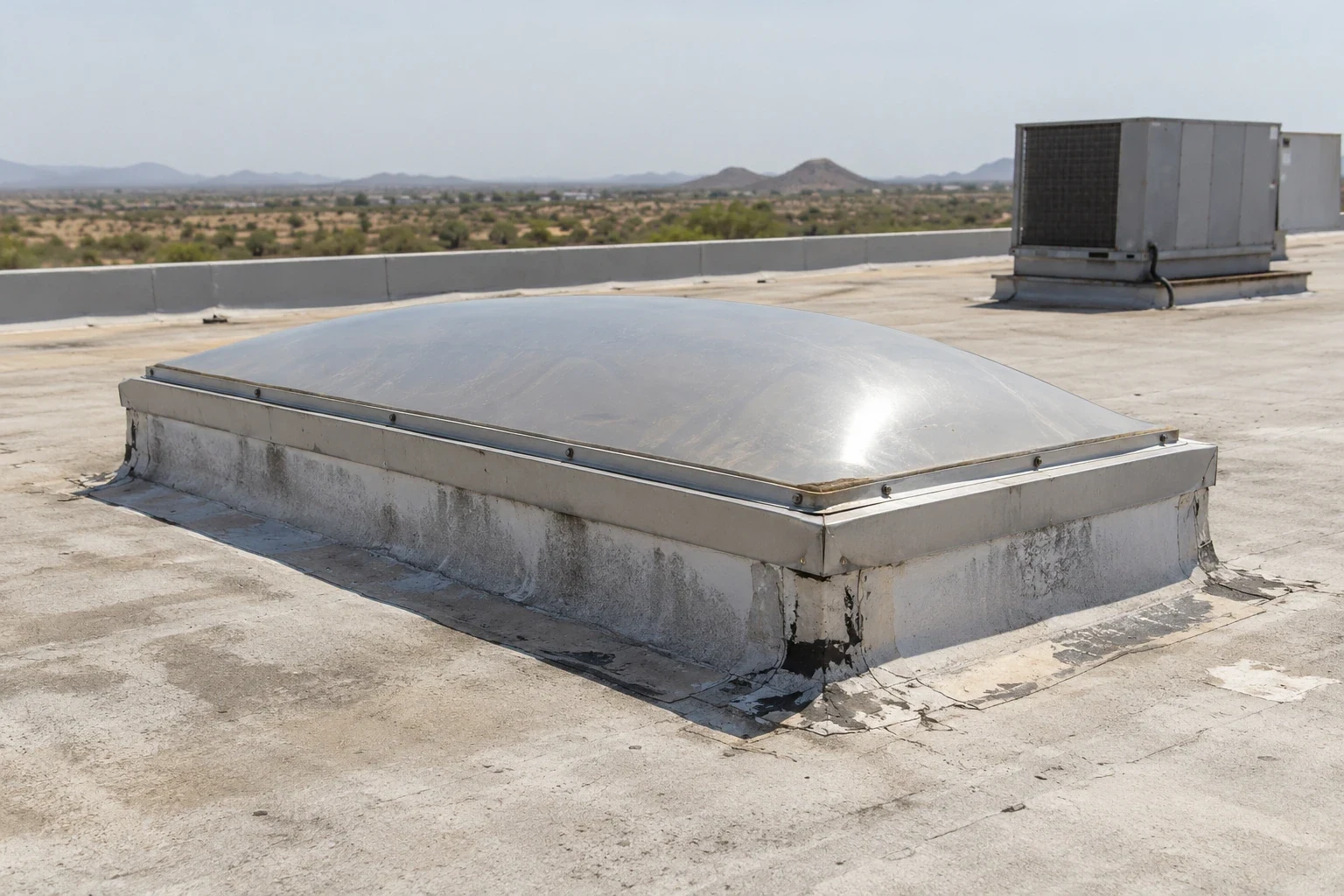
Skylight, curb and penetration flashing repair and replacement for North Las Vegas, NV commercial roofs, with attention to desert sun, wind and monsoon rain.
Every hole in a roof is a place the membrane stops and a detail begins, and most commercial leaks start at a detail. Skylights, curbs, pipes, vents, conduit, hatches and equipment supports each interrupt the roof surface, and each depends on flashing that has to stay bonded through thousands of heat cycles. The valley is hot, sunny desert with summer monsoon thunderstorms, as the Weather Service describes it. For a flashing, that means intense sun on the exposed edge most of the year and a few hard rain events that test the seal. In North Las Vegas, NV, we inspect each penetration individually, record its condition and choose a repair that suits the material around it. A commercial roof leak repair often ends at one of these details.
Inventory: Count and Classify Every Opening
The first step is a list. We walk the roof and mark each opening on the plan: skylights, smoke hatches, roof hatches, pipe stacks, vent caps, conduit supports, gas lines, refrigerant lines, exhaust fans and curb-mounted units. Each gets a number, a photograph and a note on its material and condition.
The list reveals patterns. Penetrations added after the original roof often have lighter flashing details than the ones built with it. Penetrations clustered in one area can interfere with drainage. Items that have been abandoned in place, such as capped pipes or disconnected conduits, may still be leaking at a collar that nobody maintains.
We also note who owns each item. A tenant's exhaust fan, a utility's conduit and the building's own plumbing vent may all sit on the same roof, and each owner may need to approve work. Knowing that before the repair keeps the sequence moving.
Commercial Roofing Questions
How do I tell a failed skylight seal from a roof leak?
Condensation or fogging between panes points to the glazing seal. Staining at the curb, wet insulation near the base or water on rainy days points to the roof flashing. We inspect both the unit and the curb before choosing a repair.
Should a skylight be replaced when the roof is replaced?
Often, yes. A new membrane terminates cleanly against a new curb and unit, while an old skylight can leave a weak spot in a fresh roof. The owner can also choose to remove the skylight and deck over the opening.
Why do the same pipe penetrations leak again after a patch?
Usually the patch used a material that does not bond to the old flashing, or the collar moved. We remove the failed material, clean the base and rebuild with compatible components. Then we record the detail for the next inspection.
Can flashing be repaired during hot weather?
Yes, with planning. Adhesives and sealants have temperature limits, so we start early and hold sensitive work for when the surface is workable. Heat-welded details need clean, dry membrane.
Who approves work around equipment owned by a tenant?
The tenant or the property manager does, depending on the lease. We identify owners during the inventory so approvals are in place before the crew arrives.
More Roofing Detail
COMMERCIAL ROOFING IN NORTH LAS VEGAS, NEVADA
Skylights: Domes, Frames and Curbs
A skylight has three weak points: the glazing, the frame and the curb it sits on. Domes can crack or craze in sun. Frames can corrode or open at corners. Curbs can settle or lose their flashing bond. Condensation inside a unit does not always mean a roof leak, but it can point to a failed seal that needs a different fix.
We check the curb height, the condition of the base flashing and the sealant at the frame. Roof membrane should rise on the curb to a defined height and terminate under a counterflashing or a cap. A short curb, a gap at a corner or a seam directly at a curb corner is a likely entry point. Where a skylight has reached the end of service, we compare repair, replacement and removal with infill. Removing a skylight and decking over the opening eliminates the leak path, and the owner can weigh that against the lost daylight.
Foot traffic is a risk. A skylight dome is not a walking surface, and a roof with service routes near skylights needs guards or screens.
Curbs and Equipment: Where Roof Meets Machine
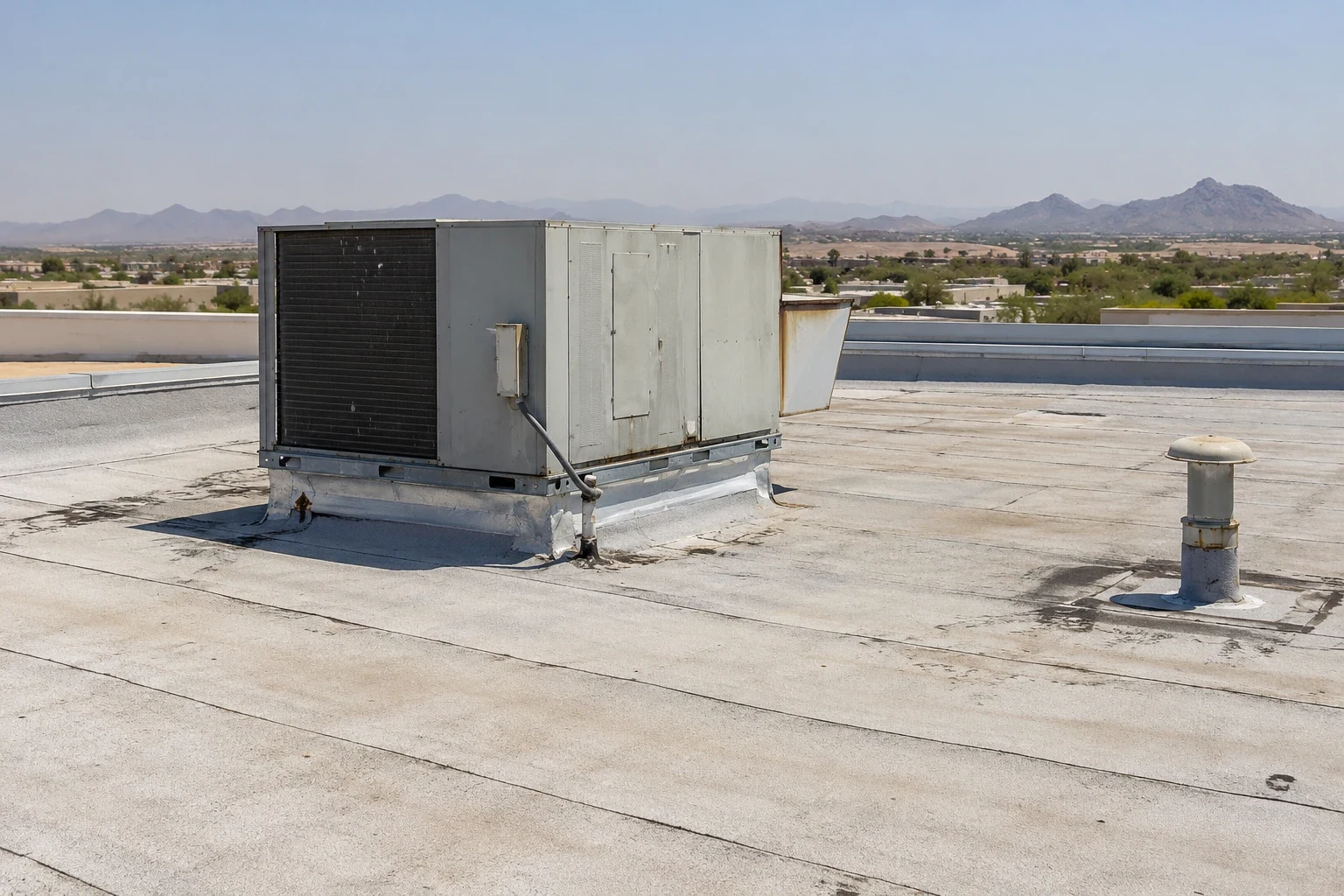
A curb transition is a repeated site of failure. Water enters at the corners, where the membrane must fold or be cut and capped, and along the base where the flashing meets the field. Heat makes it worse. Sealants dry, mastics crack and some flashing membranes shrink as they age, pulling away from the vertical face.
We probe each curb corner, check for pitch or movement, and look for patches layered over patches. A stack of repairs at one curb tells us the original detail was weak. In that case, we remove the old material down to a sound base and rebuild the flashing with compatible components. The repair should be reflected in the record so future inspections track the detail by number.
When equipment sits on the curb, the rooftop equipment curbs and supports need coordination with the mechanical contractor. Shutdown time, disconnects and lifting can all affect the repair. If a unit has been replaced, check that the curb height and flashing still match the new equipment.
Pipes, Vents and Small Penetrations
Small penetrations are easy to overlook and easy to repair. A pipe boot can crack in the sun, a pitch pocket can dry and shrink, and a clamped collar can loosen. We inspect each one for cracks, gaps at the base and sealant that no longer bonds. Where the flashing is a molded boot, replacement is straightforward. Where a field-built detail is used, we rebuild it with reinforcing fabric and a compatible liquid-applied flashing resin or with prefabricated components, depending on the membrane.
Compatibility matters. A TPO roof takes heat-welded flashing details when clean, sound membrane is available. Modified bitumen and built-up systems take different flashing methods. Adhesive and sealant that suits one membrane can damage another, so we match each repair to the existing material and test a small area when the material is unknown.
For roofs with many penetrations, we sometimes recommend grouped supports, such as a single pedestal or frame for several conduits, which reduces the number of openings to maintain.
Wind and Rain: What the Valley Adds
Wind events come more often in spring and fall. Gusts above 50 mph are uncommon, yet they can carry grit. Gusty conditions loosen caps, covers and sealants, and blowing grit abrades exposed flashing. We look for scouring, missing covers and shifted counterflashing after a wind event.
Monsoon moisture reaches the Mojave Desert each July and August, bringing storms that can drop heavy rain. A flashing that is dry for months faces driving rain with little warning. A split that was a hairline in spring can pass water in a monsoon burst. That is why the inspection record notes small defects with their location, so the next storm does not find an unmarked one.
When a flashing has pulled away or opened, the flashing failure repair comes first, before any surface treatment that would hide it.
Closeout: A Record by Opening
Each repaired opening gets a before and after photograph, a note on the materials used and a plan reference. The record separates repairs that restore the original detail from upgrades that change it, such as a taller curb or a new counterflashing. Facilities leads can then see what each dollar bought.
Cheyenne North and the Northern Development Area are planning labels for wide parts of the city. A building there still gets its own inspection record and repair history.
Share the roof plan, a list of known penetrations, leak dates and access rules. We will inventory the openings, mark the highest-risk ones and give you a repair sequence.

Request a Penetration Inventory
Send the roof plan, a list of known skylights and equipment, and any leak dates. We will walk the roof, record every opening and give your team a flashing repair sequence.