
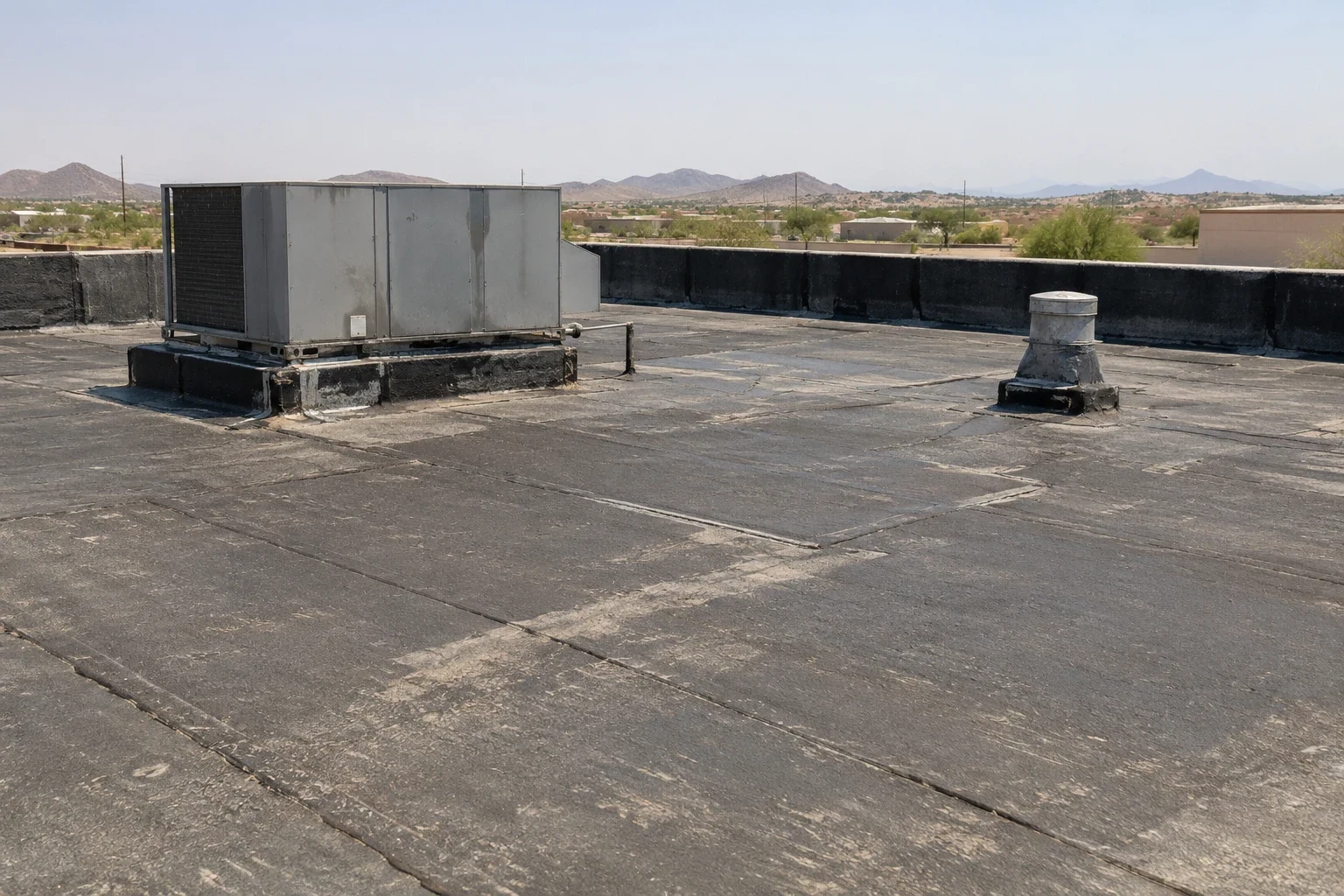
Modified bitumen roofing in North Las Vegas, NV: SBS and APP cap sheets, lap and blister checks, granule loss, flashing repair, and heat-season maintenance.
Granules collecting at the bottom of a downspout or in a scupper are the first thing a building manager can check on a modified bitumen roof, and they say more than they seem to. A little loose granule is normal on an older cap sheet. A steady stream, or bare black patches on the surface, means the mineral surface that shields the asphalt from the sun is wearing through. The inspection should establish how far that wear extends before anyone picks between a coating, a repair, and a new cap sheet.
Modified bitumen is an asphalt membrane reinforced with polymer, either SBS rubber or APP plastic, installed in one or two plies over insulation or an older roof. We inspect, repair and replace it on North Las Vegas commercial buildings. The work starts by confirming the type, the number of plies, the attachment, and the condition of laps, flashings, and drainage, since those details decide how water moves and where it gets.
Sheet Type: SBS, APP, and How They Were Applied
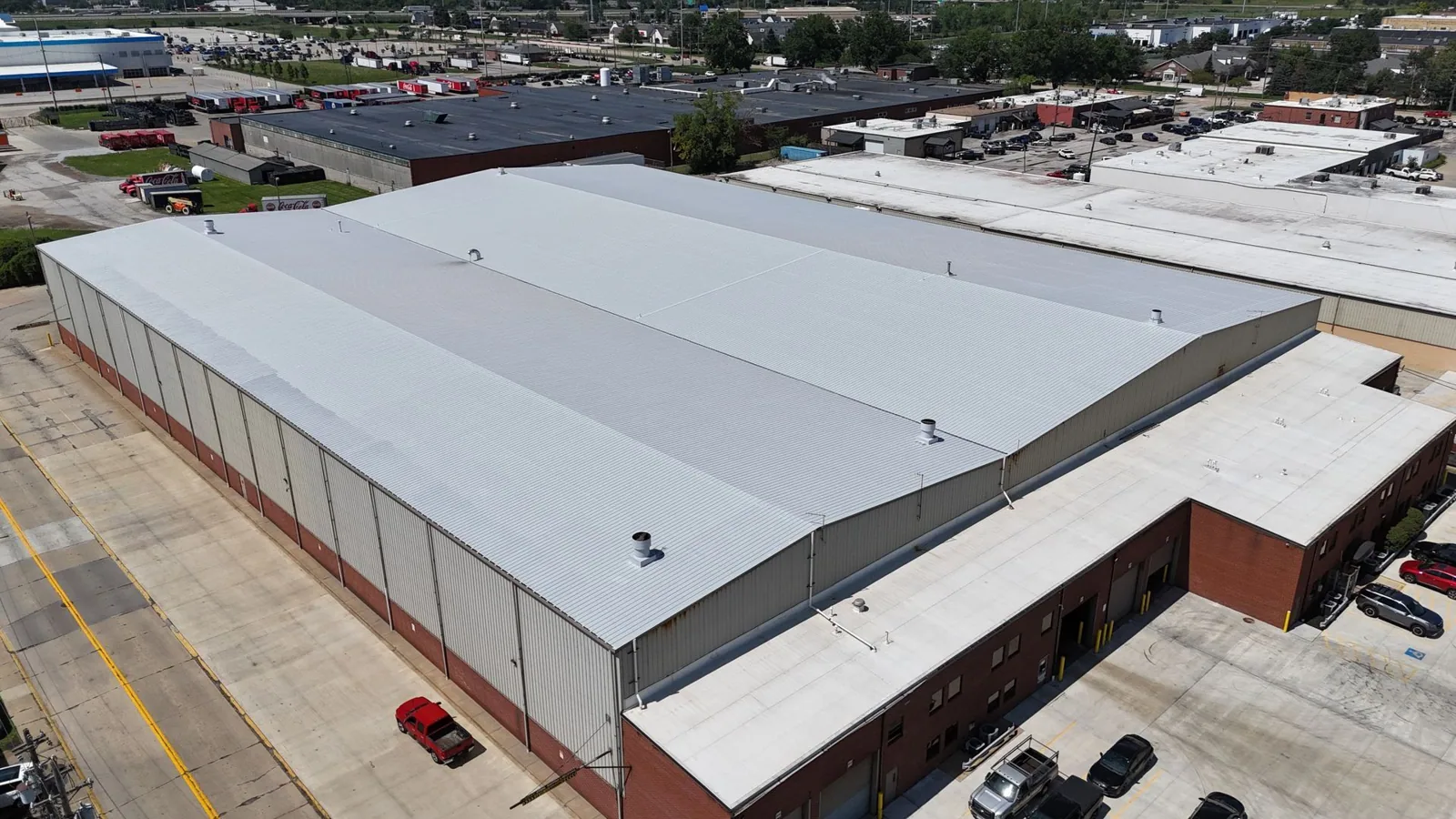
SBS sheets are rubber-modified and flexible, usually applied with hot asphalt, cold adhesive, or a self-adhering back. APP sheets are plastic-modified and stiffer, and are often torch-applied. Both are common, and the application method changes the repair. A torch-applied sheet can be re-heated to seal a lap. A self-adhering sheet needs a clean, primed surface and pressure.
We identify the type by looking at the cap sheet surface, the selvage edge at laps, the cut edge, and any records. A test cut shows the number of plies and the substrate. The record names what we found, so a crew sent to repair a lap uses the right method, and so a coating plan does not assume a surface that the roof does not have. Where the type is unclear, we say so in writing and choose the more conservative repair.
Repair materials must match the sheet. A patch of the wrong polymer type may bond at first and release when the roof heats. Primers, adhesives, and flashing cements are chosen for the sheet in place, and the record lists them by product type so later crews can see what is on the roof.
Commercial Roofing Questions
Is granule loss a reason to replace a modified bitumen roof?
Not by itself. Loss at a walk path or a scupper is local and often repairable, while widespread loss that exposes the asphalt across a slope signals surface aging. We check the laps, the insulation moisture, and whether the asphalt beneath is cracked. A roof with sound laps and dry insulation may take a coating, but one with cracked asphalt needs a new cap sheet.
What is the safest application for an occupied building?
Cold-applied and self-adhering sheets avoid an open flame and reduce fire risk, though they may carry odor from adhesives and primers. Torch work can be done with a fire plan and watch, yet many occupied buildings choose against it. We assess the building's use, intakes, and tenant sensitivities and recommend the method, then plan intake covers or shutdowns for any odor-producing steps.
Can a blister be cut open and sealed?
Sometimes. If the blister is air-filled and the insulation beneath is dry, it can be opened, dried, and sealed with a patch. If the blister holds water or the insulation is wet, cutting it only releases the symptom. We probe the area, check with a moisture survey where warranted, and decide whether the repair is a patch or a section replacement.
How do I tell SBS from APP without records?
Look at the sheet's flexibility and selvage edges, and check cut samples. SBS tends to be soft and stretchy when warm, and APP is firmer. Laboratory identification is available if the choice matters for compatibility. Until the type is known, we choose repair methods that suit both and record the uncertainty so later crews do not assume the roof is one or the other.
More Roofing Detail
COMMERCIAL ROOFING IN NORTH LAS VEGAS, NEVADA
Laps, Blisters, and Ridging: What Each One Means
Laps are the seams of a modified bitumen roof, and they open when the bond between sheets fails or when movement pulls them apart. We press and probe lap edges, looking for lifted corners, fishmouths, and dirt tracks. A short open lap is cleaned and resealed. A lap that opens repeatedly suggests movement in the insulation or deck.
Blisters are pockets of trapped air or moisture between plies. A blister over dry insulation may be opened, dried, and sealed, while one that holds water points to moisture below and needs a closer look. Ridging, a raised line along the insulation joints, shows movement in the board under the roof. Cutting a ridge flat without addressing the board starts the leak sooner. Each finding is photographed and tied to a roof zone on the plan.
Drainage ties these findings together. A roof that ponds at a lap will fail there sooner, so we measure where water stands after rain and compare it with the seam locations. Water over a lap is the pattern to expect on the next leak call.
Cap Sheet Surface: Granule Loss and Heat
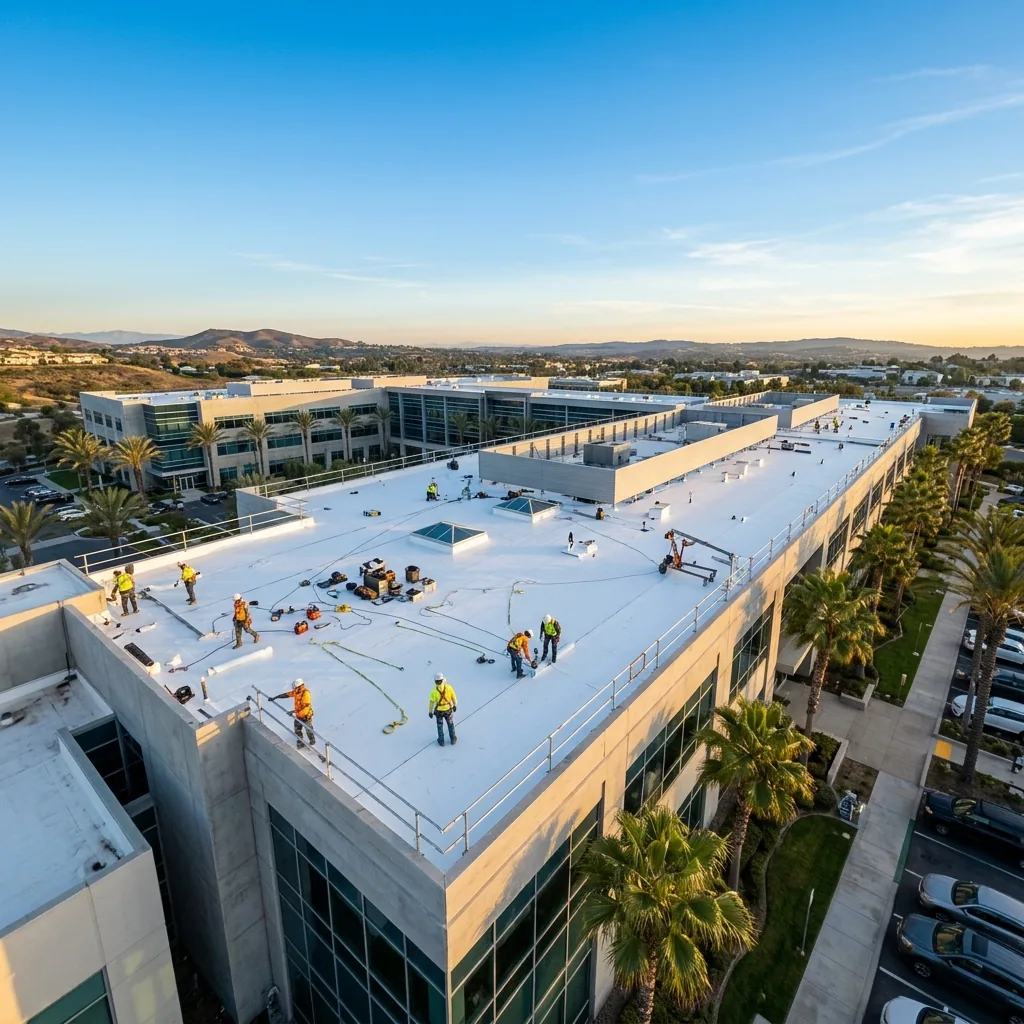
The mineral granules on the cap sheet reflect sun and protect the asphalt below. As they wear off, the asphalt is exposed to ultraviolet light and heat and begins to harden and crack. The valley is a hot, sunny desert, and that sun ages the cap sheet's surface and the asphalt beneath it.
We walk the surface, look at the pattern of loss, and check whether it follows water flow, foot traffic, or sun exposure. Local loss at an access path is a walk-pad problem. Wide, even loss across a slope is surface aging. In the second case a coating restoration may protect the asphalt, provided the laps are sound, the insulation is dry, and the surface is cleaned and primed. Acrylic and silicone coatings both go over modified bitumen with the right primer, and the choice follows how the roof drains and how much dirt it collects. Where the asphalt is already cracked through, a new cap sheet is the sound choice.
Flashing: Where Modified Bitumen Roofs Open First
Base flashings at walls, curbs, and penetrations take the most movement. They are built from separate sheets lapped onto the field, and they open at corners, at terminations, and at the back of parapets. We inspect each flashing for splits, lifting, and cracked sealant at the top edge, and note whether a counterflashing or termination bar is holding.
Repair depends on what the flashing is made of. A split in a base flashing may be cut out and replaced with new sheet lapped into the field. A lifted termination is refastened and sealed. Where a flashing has failed along a long run, the flashing failure repair scope extends to the full length, and we check the substrate behind it for water damage before closing the repair.

Hot Work, Cold Work, and Occupied Buildings
Torch-applied work uses an open flame on the roof, which brings a fire plan, a watch period after work, and restrictions near combustible material. Many buildings with occupants below prefer cold-applied or self-adhering methods, and we choose the application to suit the building's use. The choice affects odor, noise, and risk, and it is set before the schedule.
For buildings in Downtown North Las Vegas or along the North 5th Transit Corridor, which the city's planning map labels as a planning area and a main-street and transportation area, access and street frontage affect the work. We confirm staging, hoisting, and pedestrian protection in advance, and we plan around the monsoon months. The Weather Service notes monsoon moisture commonly reaches the Mojave Desert in July and August, so open areas are sized to what can be closed in a shift. Related layered systems, such as a built-up roof, follow the same sequence.
Send the Roof Plan and Repair History
Share roof plans, access rules, leak dates, repair history, equipment changes, and operating-hour constraints. We will inspect the modified bitumen roof and return a defined scope for repair, coating, or replacement.