
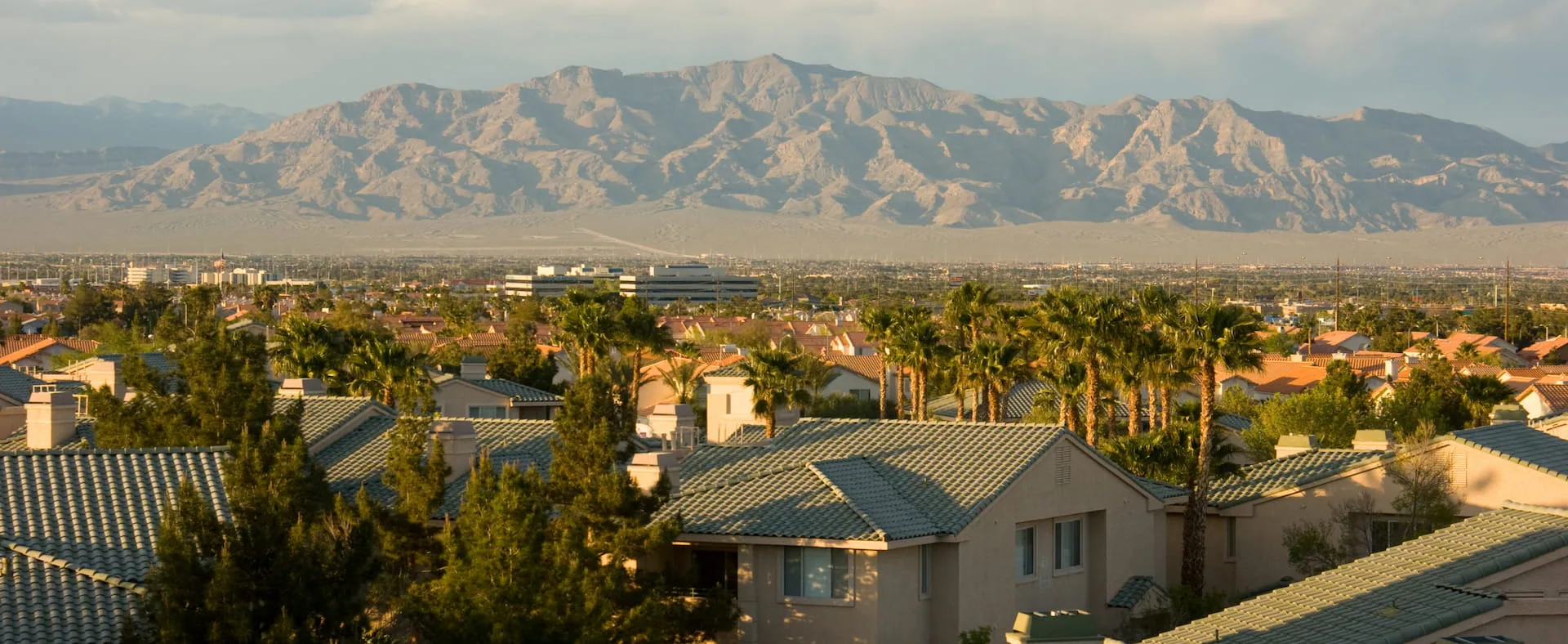
Commercial roof inspection, wind-resistance repair, metal roof service and replacement in Lone Mountain, NV, with written findings by roof zone.
Gusty spring and fall winds test a commercial roof at its edges and fasteners before they test anything else, and the check is a physical one: walk the perimeter, pull on the metal, read the fastener pattern. Lone Mountain is a named advanced-planning area on Clark County's land-use map system for the Las Vegas Valley, and the county advises owners to consult current maps for its boundary and designations. The name places a property on a planning map. It does not describe a roof. For a commercial building in Lone Mountain, NV, we inspect the actual assembly, whether it is a low-slope membrane, a metal panel roof or a mix, and document wind-resistance details first. A wind-damaged roof call tells us where to look, and a scheduled inspection finds the same weak points before the wind does.
Perimeter: edges, corners and attachment
Uplift pressure on a roof is highest at corners and perimeters, so that is where the walk starts. We check coping, fascia, drip edge and gravel stop for straightness, secure attachment and tight joints. We look at cleats and continuous bars where they exist and probe sealant at every joint. On the membrane side, we look at the edge termination, the fastener rows and any sign of peel or flutter.
A loose edge section can be re-secured or replaced as a unit. The decision depends on the metal's condition, the substrate behind it and the attachment pattern. A coping and edge metal repair that restores continuous attachment protects the membrane that terminates beneath it.
We also check parapet caps and wall flashing. In a gust, a cap that lifts exposes the wall top to rain, and water entering there can travel down inside the wall before it shows.
Fastener pull checks on a sample of perimeter plates tell us whether the attachment still holds what it was set to hold, and the results are written next to the roof-plan location.
Commercial Roofing Questions
Why does a roof edge get inspected before the middle of the roof?
Uplift concentrates at corners and perimeters, so edge metal and perimeter fasteners take the highest load. A failure there can spread inward, while a field defect usually stays local.
How do you tell loose fasteners from a failed panel?
Backed-out fasteners can be tightened or replaced with a larger diameter, and the washer renewed. A panel with fatigue cracks, corrosion at a cut edge or deformed ribs is a replacement item.
Does blowing dust really damage a roof?
It clogs drainage points, abrades surfaces and hides openings. Cleaning and inspecting after dusty periods keeps those effects from building.
What goes into a roof report for a property sale?
Assembly type, condition by zone, drainage review, penetrations, repair history, moisture findings if tested and photographs tied to a plan. The report states what was not examined.
Can a metal roof be retrofitted without a tear-off?
Sometimes. The structure must carry the added system, the old roof must be sound enough to support it and code review must allow it. Test and structural review come before any price.
More Roofing Detail
COMMERCIAL ROOFING IN NORTH LAS VEGAS, NEVADA
Metal roofs: panels, fasteners, seams and sealant
Metal roofing fails in recognizable ways. Exposed fasteners back out over many thermal cycles, and the washers that seal them age in the sun. Panel laps open as the metal moves. Sealant at ridges, curbs and penetrations dries and cracks. Cut edges corrode when finish is damaged. Standing seam panels can have loose clips or open seams at terminations.
We inspect by section. For exposed-fastener panels, we check fastener tightness and washer condition along each rib. For standing seam, we check clips, seam closure and end details. At every curb and penetration we check the flashing and the sealant. The report records the fastener count replaced or the sealant renewed, by roof zone.
When a metal roof is past routine repair but the structure is sound, a metal roof retrofit can add a new panel system over the old one, subject to a structural and code review. We do not assume that path is open until the existing roof is tested.
Dust and sand: what blowing grit does to a roof
Spring and fall bring the valley's more frequent wind events, and the rare gust above 50 mph can carry blowing dust and sand. That is regional context for Lone Mountain, not a measurement at any property. On a roof, grit has three effects.
It collects. Drain bowls, scupper throats and the back sides of curbs fill with fines, and the next rain finds a blocked path. It abrades. Membrane surfaces and coatings thin where grit rides the wind, and bare reinforcement may show. And it hides. A layer of dust over a seam can mask an opening until it is cleaned.
The response is routine. Clear the drainage points after dusty periods, inspect for abrasion, and clean before judging a surface. A maintenance visit after the spring winds is cheap compared with repairing the water damage a clogged drain can cause.
Rooftop equipment collects grit too. Condenser coils, intake screens and unit bases hold dust that traps moisture against the roof surface, so we note it for the mechanical contractor.
Water: monsoon rain on a dry roof
Summer monsoon storms bring gusts and brief, heavy rain to the valley as well. For a roof that has been dry for weeks, the first hard rain is the real test. Seams, flashings and fasteners that were marginal show it. We trace the water path from interior stains to the roof: along the deck, through insulation, past the nearest drain, curb or penetration.
If a leak shows up, we separate the active entry from the damage downstream. A commercial roof leak repair fixes the entry. Wet insulation, if present, is mapped and replaced to a defined boundary. We do not patch over damp board.
Drainage gets its own review. Slope, outlet condition, overflow routes and ponding marks tell us if the roof can handle a burst. Where it cannot, we propose a correction before any membrane work.
Records: due diligence and ownership change
Owners buying, selling or refinancing need a roof record they can rely on. A written condition report gives the assembly type, surface condition, drainage, penetrations, repair history and remaining-service notes, all tied to photographs and a roof plan. A buyer can use it to price repairs. A seller can use it to avoid surprises in negotiation. A lender can use it to see whether a reserve is needed.
We build the report from the roof, not from assumptions. Where records are missing, the file says so. Where testing was not done, the file says that too and identifies what testing would settle the question.
Owners with roofs in Spring Valley or the Northern Development Area can use the same report format across properties, which makes a comparison between buildings straightforward.
Permits: confirm the map before the design
Owners should check the project address against the county's current land-use map and confirm the reviewing agency. Replacement, retrofit and some repair scopes can raise permit and code questions. The state's 2024 energy conservation code adoption means insulation and reflectivity questions deserve an early check with the reviewing agency. A reroof that opens the assembly can pull those requirements into the scope, and the answer changes board thickness, termination heights and cost.
Share the roof plan, any inspection reports, leak dates and access rules. We will walk the roof, record edges and fasteners by zone and send a written scope.

Schedule a Lone Mountain Roof Inspection
Share the roof plan, inspection history and access rules. We will walk the edges, fasteners and drainage, record findings by zone and give you a scope that fits the roof.